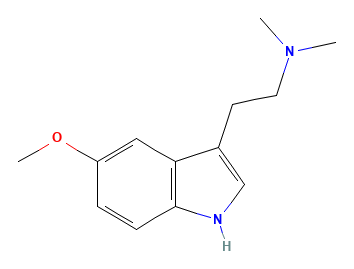
5-MeO-DMT
Extremely potent psychedelic tryptamine. Produces ego-dissolving experiences often described as more intense than N,N-DMT.
Important information
This information is for educational purposes only. Always research thoroughly, test your substances, understand legal implications, and consult healthcare professionals. Never use substances alone or in unsafe environments.
Risks & side effects
- Extreme intensity
- Physical incapacitation
- Respiratory depression risk
- Psychological overwhelm
- Dangerous combinations
Read the interactions and harm-reduction information below before the reference ranges.
Known interactions
Unsafe 5-MeO-DMT + MDMA (Ecstasy/Molly)
5-MeO-DMT is a potent serotonin agonist. Combined with MDMA's serotonin release, serotonin syndrome risk is significant.
Risks: Serotonin syndrome · Hyperthermia · Seizures · Extreme psychological distress
Mechanism: 5-MeO-DMT strongly agonizes 5-HT1A/2A. MDMA releases serotonin. Combined serotonergic load may cause toxicity.
What reduces the risk
- Do not combine 5-MeO-DMT with MDMA
- Allow at least 24 hours between use
- 5-MeO-DMT should generally not be combined with other substances
Sources: PsychonautWiki: 5-MeO-DMT Interactions · TripSit Interaction Chart · Shulgin A, Shulgin A. TiHKAL. 1997
Unsafe 5-MeO-DMT + Kanna (Sceletium tortuosum)
Kanna's SRI properties combined with 5-MeO-DMT's strong serotonin agonism creates serotonin syndrome risk.
Risks: Serotonin syndrome · Hyperthermia · Seizures
Mechanism: Kanna inhibits serotonin reuptake while 5-MeO-DMT directly activates serotonin receptors, increasing synaptic serotonin to dangerous levels.
What reduces the risk
- Do not combine
- Allow at least 24 hours washout period
Sources: PsychonautWiki: 5-MeO-DMT Interactions · TripSit Interaction Chart
Absence of a listed interaction never implies safety. Check any combination in the app's 23×23 interaction matrix.
Harm reduction
- Experienced sitter essential
- Precise dosing critical
- Safe physical environment
- Test substance
- Never combine with MAOIs or other substances
- Mental health screening
Dosage information
5-MeO-DMT · Vaporized · non-clinical reference ranges
Tier labels reproduce reported amount and intensity terminology; they do not indicate safety or a recommendation.
| Tier | Amount | Note |
|---|---|---|
| Threshold | 2 to 5 milligrams | |
| Light | 5 to 10 milligrams | |
| Common | 10 to 15 milligrams | |
| Strong | 15 to 20 milligrams | |
| Heavy | Reported lower bound: 20 milligrams; no upper bound is established. |
Dosage ranges are reference values from published literature, not recommendations. Potency varies by source, body weight, and individual sensitivity — harm-reduction practice starts well below the ranges listed.
Limitations: Figures are transcribed from a reference compilation, not measured in a controlled study; the potency of any given material is unknown until tested.
Evidence: Review or reference work
Before any number: set, setting, purity, dose · LD50 · microdosing
On this page: known interactions · harm reduction
Duration
15-45 minutes total | Peak: 5-20 minutes
15-45 minutes total. Peak: 5-20 minutes. Extremely intense.
Effects
- Complete ego dissolution
- Non-dual awareness
- White light experiences
- Timelessness
- Unity consciousness
Legal status
Schedule I in USA and most countries. Illegal to possess.
Pharmacology
Potent 5-HT1A and 5-HT2A agonist. Found in certain toads and plants.
Therapeutic research
- Johns Hopkins: Survey study showing 80% of respondents reported improvements in anxiety and depression (Davis et al., 2019)
- University of Maastricht: Naturalistic study showing sustained improvements in satisfaction with life and mindfulness (Uthaug et al., 2019)
- Research into ego dissolution and mystical-type experiences as therapeutic mechanisms
- Preliminary investigations into 5-MeO-DMT for substance use disorders
- GH Research: Phase 1/2 clinical trial of synthetic 5-MeO-DMT (Mebufotenin) for treatment-resistant depression
Research
A preview of the linked research. The library includes different kinds of evidence; read each source for its methods and limitations.
5-MeO-DMT modifies innate behaviors and promotes structural neural plasticity in mice
Jefferson et al. 2023 Neuropsychopharmacology study showing 5-MeO-DMT affects behavioral patterns and promotes dendritic spine growth in rodent brain tissue.
Overall 2025 Applied Psychology Research. Mixed-methods analysis examining 5-MeO-DMT's role in mental health and intergenerational healing processes.
A Toad Less Traveled: Should 5-MeO-DMT Have a Role in Treating Depression?
Hayes 2025 Psychedelic Medicine. Review examining evidence for 5-MeO-DMT in depression treatment and its therapeutic potential.
Sources 1
History & culture
5-MeO-DMT has been used for centuries by indigenous peoples of the Orinoco Basin in South America as part of yopo and vilca snuffs prepared from Anadenanthera seeds. The Sonoran Desert toad (Incilius alvarius, formerly Bufo alvarius) secretes 5-MeO-DMT in its venom glands — toad venom smoking rituals emerged in the 1980s, though claims of ancient indigenous toad use are disputed. The compound was first synthesized in 1936 by Toshio Hoshino. Its pharmacology was characterized in the 1950s–60s. The modern 5-MeO-DMT movement has raised conservation concerns about Sonoran Desert toad populations.
Natural origins
Found naturally in the venom of the Sonoran Desert toad (Incilius alvarius), native to northern Mexico and the southwestern United States. Also present in several plant species including Anadenanthera peregrina and Virola species. The toad secretes 5-MeO-DMT alongside bufotenin from parotoid glands as a defense mechanism. Conservation note: wild toad populations face pressure from collection — synthetic 5-MeO-DMT is chemically identical and avoids ecological harm. The compound also occurs endogenously in mammalian brains.
Molecular family: Tryptamines
Tryptamines share an indole-based chemical scaffold. This family includes psilocybin, DMT, and 5-MeO-DMT. Their effects and duration differ, and family membership is not a safety ranking. 5-MeO-DMT can produce intense psychedelic experiences.
Structurally related to Serotonin (5-HT)