N,N-DMT (Dimethyltryptamine)
Powerful, short-acting psychedelic tryptamine found in many plants and animals. Produces intense visual and psychological effects.
Important information
This information is for educational purposes only. Always research thoroughly, test your substances, understand legal implications, and consult healthcare professionals. Never use substances alone or in unsafe environments.
Risks & side effects
- Overwhelming intensity
- Psychological distress
- Cardiovascular strain
- Dangerous with MAOIs
- HPPD (rare)
Read the interactions and harm-reduction information below before the reference ranges.
Known interactions
Caution N,N-DMT + MDMA (Ecstasy/Molly)
DMT is commonly consumed with MAOIs in ayahuasca preparations. MDMA combined with MAOIs is life-threatening. Ensure MAOI has fully cleared before MDMA use.
Risks: Serotonin syndrome (potentially fatal) · Hyperthermia · Seizures · Hypertensive crisis
Mechanism: MAO inhibition prevents serotonin breakdown; MDMA floods serotonin. Combined = serotonin syndrome.
What reduces the risk
- If using ayahuasca, wait at least 2 weeks before MDMA
- Never combine MDMA with any MAOI
- Know if your DMT preparation contains MAOIs
Sources: TripSit Interaction Chart · PsychonautWiki: MDMA Interactions · Gillman PK. Monoamine oxidase inhibitors, opioid analgesics and serotonin toxicity. Br J Anaesth. 2005
Absence of a listed interaction never implies safety. Check any combination in the app's 23×23 interaction matrix.
Harm reduction
- Comfortable, safe location
- Sitter highly recommended
- Sitting or lying position
- Test substance
- Start with lower dose
- Mental preparation
Dosage information
N,N-DMT · Vaporized · non-clinical reference ranges
Tier labels reproduce reported amount and intensity terminology; they do not indicate safety or a recommendation.
| Tier | Amount | Note |
|---|---|---|
| Light | 10 to 20 milligrams | |
| Common | 20 to 40 milligrams | |
| Strong | 40 to 60 milligrams | |
| Breakthrough | Reported lower bound: 60 milligrams; no upper bound is established. |
Dosage ranges are reference values from published literature, not recommendations. Potency varies by source, body weight, and individual sensitivity — harm-reduction practice starts well below the ranges listed.
Limitations: Figures are transcribed from a reference compilation, not measured in a controlled study; the potency of any given material is unknown until tested.
Evidence: Review or reference work
Before any number: set, setting, purity, dose · LD50 · microdosing
On this page: known interactions · harm reduction
Duration
Vaporized: 5-15 minutes total | Oral with MAOI: 2-6 hours
Vaporized: 5-15 minutes active. Extremely rapid onset.
Oral with MAOI (ayahuasca): 2-6 hours. Requires MAOI to be active orally.
Effects
- Breakthrough experiences
- Entity encounters
- Geometric visual patterns
- Time dissolution
- Profound insights
- Spiritual experiences
Legal status
Schedule I in most countries. Naturally occurring in many plants.
Pharmacology
5-HT2A receptor agonist. Naturally occurs in human body. Broken down by MAO.
Therapeutic research
- Rick Strassman's pioneering study: First FDA-approved psychedelic research in a generation (1990–1995)
- Imperial College London: DMT neuroimaging studies revealing brain dynamics during altered states (Timmermann et al., 2019)
- Ayahuasca research: Antidepressant effects in treatment-resistant depression (Palhano-Fontes et al., 2019)
- Small Pharma (now Cybin): Phase 2a trial of DMT-assisted therapy for major depressive disorder
- Research into DMT's role as an endogenous compound — found naturally in human cerebrospinal fluid
- Studies on near-death-like experiences induced by DMT (Imperial College, 2018)
Research
A preview of the linked research. The library includes different kinds of evidence; read each source for its methods and limitations.
Human brain effects of DMT assessed via EEG-fMRI
Timmermann et al. 2023 PNAS study using combined EEG-fMRI to map DMT's effects on brain activity in 20 healthy volunteers. First study to capture DMT's neural signature with this methodology.
DMT alters cortical travelling waves
Alamia et al. 2020 eLife study showing DMT alters direction and magnitude of oscillatory travelling waves in visual cortex during eyes-closed states.
A Model for Target-Controlled Intravenous Infusion for Prolonged DMT Experience
Gallimore & Strassman 2016 paper proposing methodology for extended-state DMT research using anesthesiology infusion techniques. Published in Frontiers in Pharmacology.
Sources 2
- Classic hallucinogens and mystical experiences: phenomenology and neural correlates. Current Topics in Behavioral Neurosciences, 36, pp. 393-430 (2018) doi:10.1007/7854_2017_474
- Erowid DMT Vault
History & culture
DMT has been used for millennia in South American shamanic traditions, primarily as ayahuasca — a brew combining DMT-containing plants (Psychotria viridis or Mimosa hostilis) with MAO-inhibiting Banisteriopsis caapi vine. Archaeological evidence from a 1,000-year-old ritual bundle found in Bolivia contained DMT, harmine, and cocaine residues. The compound was first synthesized by Canadian chemist Richard Manske in 1931, but its psychoactive properties weren't recognized until Hungarian chemist Stephen Szára self-administered it in 1956. Rick Strassman's groundbreaking DEA-approved study at the University of New Mexico (1990–1995) earned DMT the nickname 'The Spirit Molecule.'
Natural origins
DMT occurs widely in nature — found in hundreds of plant species across families including Fabaceae, Acanthaceae, and Rubiaceae. Key sources include Psychotria viridis (chacruna, used in ayahuasca), Mimosa tenuiflora (jurema, Brazilian traditional use), and Anadenanthera peregrina (yopo snuff). DMT is also endogenous to mammals, including humans — it has been detected in human blood, urine, and cerebrospinal fluid, though its physiological role remains debated. The Bufo alvarius toad contains 5-MeO-DMT (not N,N-DMT).
Molecular family: Tryptamines
Tryptamines share an indole-based chemical scaffold. This family includes psilocybin, DMT, and 5-MeO-DMT. Their effects and duration differ, and family membership is not a safety ranking. 5-MeO-DMT can produce intense psychedelic experiences.
Structurally related to Serotonin (5-HT)
External resources
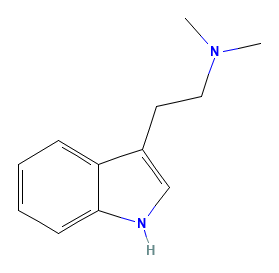
Rotate and inspect N,N-Dimethyltryptamine in Molecule Studio — right in your browser