LSD (Lysergic Acid Diethylamide)
Semisynthetic psychedelic derived from ergot alkaloids. One of the most potent psychedelics known, with effects lasting 8-12 hours.
Important information
This information is for educational purposes only. Always research thoroughly, test your substances, understand legal implications, and consult healthcare professionals. Never use substances alone or in unsafe environments.
Risks & side effects
- Challenging psychological experiences
- HPPD (rare)
- Exacerbation of mental health conditions
- Unsafe behavior during trip
Read the interactions and harm-reduction information below before the reference ranges.
Known interactions
Caution LSD + THC (Tetrahydrocannabinol)
Cannabis commonly intensifies and extends LSD experiences. Can trigger anxiety or challenging experiences, especially at the peak.
Risks: Intensified and potentially overwhelming effects · Anxiety and paranoia · Thought loops · Extended duration
Mechanism: CB1 modulation of serotonin pathways amplifies psychedelic effects unpredictably.
What reduces the risk
- Experienced users only
- Use minimal cannabis if at all
- Best avoided during peak effects
- Have a sitter present
Sources: TripSit Interaction Chart · PsychonautWiki: LSD Interactions
Caution LSD + MDMA (Ecstasy/Molly)
Known as 'candy flipping.' MDMA intensifies and alters the LSD experience. While popular, it increases neurotoxicity risk and unpredictability.
Risks: Increased neurotoxicity · Overwhelming intensity · Hyperthermia · Dehydration · Serotonin depletion
Mechanism: Both are serotonergic. MDMA's serotonin release modulates and intensifies LSD's 5-HT2A effects.
What reduces the risk
- Experienced users only with both substances
- Take MDMA 3-4 hours after LSD for safer timing
- Reduce doses of both substances
- Stay hydrated, monitor temperature
Sources: TripSit Interaction Chart · PsychonautWiki: MDMA Combinations · Erowid: Candy Flipping Reports
Caution LSD + Psilocybin
Both act on 5-HT2A receptors. Combining amplifies effects unpredictably and dramatically increases intensity.
Risks: Extremely intense experience · Prolonged duration · Difficult to predict effects · Psychological overwhelm
Mechanism: Both are 5-HT2A agonists. Cross-tolerance exists but combining increases total receptor activation.
What reduces the risk
- Not recommended for most users
- If combining, reduce doses of both significantly
- Have a sitter present
- Prepare for a long experience
Sources: TripSit Interaction Chart · PsychonautWiki: LSD Interactions
Absence of a listed interaction never implies safety. Check any combination in the app's 23×23 interaction matrix.
Harm reduction
- Test with reagent kit
- Accurate dosing essential
- Safe environment
- Trip sitter recommended
- 12+ hour time commitment
- Avoid if family history of psychosis
Dosage information
LSD · Oral · non-clinical reference ranges
Tier labels reproduce reported amount and intensity terminology; they do not indicate safety or a recommendation.
| Tier | Amount | Note |
|---|---|---|
| Threshold | 25 micrograms | |
| Light | 50 to 75 micrograms | |
| Common | 75 to 150 micrograms | |
| Strong | 150 to 300 micrograms | |
| Heavy | Reported lower bound: 300 micrograms; no upper bound is established. |
Dosage ranges are reference values from published literature, not recommendations. Potency varies by source, body weight, and individual sensitivity — harm-reduction practice starts well below the ranges listed.
Limitations: Figures are transcribed from a reference compilation, not measured in a controlled study; the potency of any given material is unknown until tested.
Evidence: Review or reference work
Before any number: set, setting, purity, dose · LD50 · microdosing
On this page: known interactions · harm reduction
Duration
Total: 8-12 hours | Onset: 30-90 minutes | Peak: 3-5 hours
Total: 8-12 hours. Long-acting — plan for a full day.
Sublingual absorption may be slightly faster onset than swallowed.
Effects
- Profound visual hallucinations
- Ego dissolution
- Time distortion
- Synesthesia
- Euphoria
- Enhanced pattern recognition
- Emotional amplification
Legal status
Schedule I internationally. No accepted medical use in most jurisdictions.
Pharmacology
Partial agonist at 5-HT2A receptors. Extremely high binding affinity.
Therapeutic research
- Early research (1950s–60s): Over 1,000 papers published on LSD-assisted psychotherapy before prohibition
- University of Basel: LSD-assisted psychotherapy for anxiety associated with life-threatening illness (Gasser et al., 2014)
- Imperial College London: LSD neuroimaging revealing increased brain connectivity and entropy (Carhart-Harris et al., 2016)
- University of Chicago: Microdosing studies examining cognitive and emotional effects (Family et al., 2020)
- MindMed: Phase 2b trial for generalized anxiety disorder (ongoing)
- Research into LSD for cluster headaches shows promising anecdotal evidence
Research
A preview of the linked research. The library includes different kinds of evidence; read each source for its methods and limitations.
Direct comparison of LSD and psilocybin in a double-blind placebo-controlled study
Holze et al. 2022 landmark study directly comparing LSD (100/200µg) and psilocybin (15/30mg) in 28 healthy volunteers. First rigorous head-to-head comparison. Published in Neuropsychopharmacology.
Increased Global Functional Connectivity Correlates with LSD-Induced Ego Dissolution
Tagliazucchi, Carhart-Harris et al. 2016 Current Biology. fMRI study showing LSD increases brain functional connectivity, with connectivity changes correlating with subjective ego dissolution experience.
LSD microdosing in major depressive disorder: results from an open-label trial
Muthukumaraswamy et al. 2026 Neuroscience Applied. Open-label trial examining LSD microdosing effects on major depressive disorder symptoms.
Sources 2
- LSD-assisted psychotherapy for anxiety associated with a life-threatening disease. The Journal of Nervous and Mental Disease, 202(7), pp. 513-520 (2014) doi:10.1097/NMD.0000000000000113
- Erowid LSD Vault
History & culture
LSD was first synthesized by Albert Hofmann at Sandoz Laboratories in Basel, Switzerland on November 16, 1938, from ergotamine derived from the ergot fungus. Its psychoactive properties were discovered accidentally on April 19, 1943 — now celebrated as 'Bicycle Day' — when Hofmann absorbed a small amount through his skin and rode his bicycle home during the first intentional LSD trip. The CIA's MKUltra program (1953–1973) covertly tested LSD for mind control. The 1960s saw widespread cultural adoption through figures like Timothy Leary, Ken Kesey's Merry Pranksters, and the Grateful Dead. It was made illegal in the US in 1968.
Natural origins
LSD is semisynthetic — derived from ergotamine, an alkaloid produced by the ergot fungus (Claviceps purpurea) that parasitizes rye and other cereal grains. Ergot has a dark history: mass ergot poisoning ('St. Anthony's Fire') caused convulsions, gangrene, and hallucinations throughout medieval Europe. Some historians theorize that the kykeon consumed during the Eleusinian Mysteries of ancient Greece may have contained ergot alkaloids. Hawaiian baby woodrose (Argyreia nervosa) and morning glory (Ipomoea) seeds contain the related compound LSA (ergine).
Molecular family: Ergolines
Ergolines are alkaloids based on the ergoline scaffold, which fuses an indole group with a four-membered pyrrolidine ring. This complex tricyclic structure is found in ergot fungi (Claviceps purpurea) and produces the most potent psychedelic known. LSD is a semisynthetic lysergic acid amide derived from lysergic acid, an ergoline precursor. Key characteristics: - Tricyclic ergoline scaffold (indole + pyrrolidine) - Present in ergot-infected grains and natural ergot fungi - LSD is a semisynthetic modification of lysergic acid - Longest-acting of all classical psychedelics - One of the most powerful substances known (active at ~100 micrograms) The ergoline structure represents an elegant solution by nature to creating powerful compounds. Lysergic acid is the natural backbone, while LSD's synthesis adds the diethylamide group—this single modification fundamentally changed consciousness research and culture.
Structurally related to None identified
External resources
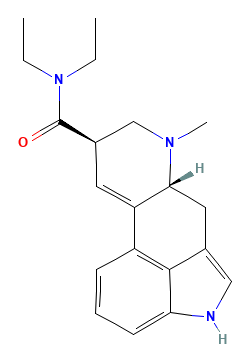
Rotate and inspect Lysergic acid diethylamide in Molecule Studio — right in your browser