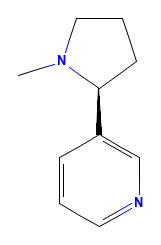
Nicotine
The primary psychoactive alkaloid in tobacco, and among the most widely used stimulants on earth. Nicotine itself is a comparatively mild stimulant; most of the well-known harm from smoking comes from combustion products rather than from nicotine, while the dependence comes from nicotine.
Important information
This information is for educational purposes only. Always research thoroughly, test your substances, understand legal implications, and consult healthcare professionals. Never use substances alone or in unsafe environments.
Risks & side effects
- Rapid and strong dependence
- Withdrawal — irritability, anxiety, difficulty concentrating
- Increased heart rate and blood pressure
- Nausea and dizziness at higher doses, especially in non-tolerant users
- Poisoning risk from concentrated liquids, particularly for children
- Harm to fetal development in pregnancy
Read the interactions and harm-reduction information below before the reference ranges.
Known interactions
Caution Nicotine + Fentanyl
Nicotine is a far weaker stimulant than cocaine or amphetamine, and this is not the same risk as those combinations. It still shifts how sedated a person feels without changing what fentanyl does to breathing.
Risks: Sedation judged by how alert someone feels rather than by the dose taken · No protection against respiratory depression · Disrupted sleep across a long opioid offset
Mechanism: Raised alertness can make an opioid feel less sedating than it is. The masking is much weaker than with a potent stimulant, and it offers no protection against respiratory depression.
What reduces the risk
- Do not read alertness as a sign the opioid has worn off
- Never use a stimulant to counteract opioid sedation
- Keep naloxone within reach and do not dose alone
Sources: NIDA Research Topics: Polysubstance Use
Caution Nicotine + Heroin (Diacetylmorphine)
Nicotine is a far weaker stimulant than cocaine or amphetamine, and this is not the same risk as those combinations. It still shifts how sedated a person feels without changing what heroin does to breathing.
Risks: Sedation judged by how alert someone feels rather than by the dose taken · No protection against respiratory depression · Disrupted sleep across a long opioid offset
Mechanism: Raised alertness can make an opioid feel less sedating than it is. The masking is much weaker than with a potent stimulant, and it offers no protection against respiratory depression.
What reduces the risk
- Do not read alertness as a sign the opioid has worn off
- Never use a stimulant to counteract opioid sedation
- Keep naloxone within reach and do not dose alone
Sources: NIDA Research Topics: Polysubstance Use
Absence of a listed interaction never implies safety. Check any combination in the app's 23×23 interaction matrix.
Harm reduction
- Combustion causes most smoking-related disease — non-combusted routes carry different, generally lower risk profiles
- Concentrated e-liquid can be acutely toxic; store it away from children and pets
- Effects build fast and dependence forms faster than most people expect
- Nicotine raises heart rate and blood pressure — relevant with stimulants or existing cardiac conditions
- Cessation support genuinely improves success rates; abrupt unaided quitting has the lowest
Dosage information
One cigarette delivers roughly 1-2mg absorbed | Typical pouch or lozenge: 2-8mg | Acute toxicity in adults is generally reported above roughly 30-60mg, though tolerance shifts this substantially
Dosage ranges are reference values from published literature, not recommendations. Potency varies by source, body weight, and individual sensitivity — harm-reduction practice starts well below the ranges listed.
Before any number: set, setting, purity, dose · LD50 · microdosing
On this page: known interactions · harm reduction
Duration
Acute effects: 30-60 minutes | Half-life: about 2 hours
Reaches the brain within seconds of inhalation — that speed is a major driver of dependence. Craving typically returns within 30-60 minutes.
Pouches, gum and lozenges absorb through the mouth — slower onset and a lower peak than inhalation.
Effects
- Increased alertness
- Improved concentration
- Mild euphoria on first use
- Appetite suppression
- Relaxation in dependent users
- Faster reaction time
Legal status
Legal for adults in most jurisdictions, typically with age restrictions, taxation and marketing limits. Flavored and disposable vape products are restricted or banned in a growing number of places.
Pharmacology
Agonist at nicotinic acetylcholine receptors. Stimulates dopamine release in the mesolimbic reward pathway, which underlies its reinforcing effect. Absorption is fastest by inhalation, reaching the brain within seconds — speed of delivery is a major driver of dependence.
Therapeutic research
- Nicotine replacement therapy (patch, gum, lozenge, inhaler) is established for smoking cessation and is on the WHO Model List of Essential Medicines
- Research interest in nicotinic receptor modulation for cognition in Alzheimer's disease and schizophrenia — mechanistic, not an approved treatment
- Studied for attention and working memory effects; findings are modest and do not support use as a nootropic
- Investigated in ulcerative colitis, where transdermal nicotine showed some benefit in trials
History & culture
Tobacco (Nicotiana) was cultivated and used ceremonially across the Americas for thousands of years before European contact, and remains sacred in many Indigenous traditions — a context routinely erased by its commercial history. Jean Nicot, French ambassador to Portugal, sent tobacco to the French court in 1560 and gave the plant and the alkaloid their names. Nicotine was isolated in 1828 by Posselt and Reimann at Heidelberg. Mass-produced cigarettes arrived with automated rolling in the 1880s, and the 1964 US Surgeon General's report marked the turn toward acknowledging tobacco's health consequences. Nicotine replacement therapy followed in the 1980s, and non-combusted nicotine products reshaped use patterns again from the 2010s.
Natural origins
Produced by plants in the nightshade family (Solanaceae), overwhelmingly Nicotiana tabacum and Nicotiana rustica, where it acts as a natural insecticide concentrated in the leaves. Trace amounts occur in other nightshades — tomatoes, potatoes, eggplant, peppers — but at concentrations thousands of times lower than tobacco, far below any psychoactive threshold. Most nicotine in commercial products is extracted from tobacco leaf, though synthetic nicotine has entered the market partly to sidestep tobacco-specific regulation.