THC (Tetrahydrocannabinol)
Primary psychoactive compound in cannabis. Produces euphoria, relaxation, and altered sensory perception. Used medically and recreationally.
Important information
This information is for educational purposes only. Always research thoroughly, test your substances, understand legal implications, and consult healthcare professionals. Never use substances alone or in unsafe environments.
Risks & side effects
- Anxiety/paranoia
- Impaired memory and cognition
- Dependency with heavy use
- Respiratory issues (smoking)
- CHS (rare)
- Impaired driving
Read the interactions and harm-reduction information below before the reference ranges.
Known interactions
Caution THC + Psilocybin
Cannabis can dramatically intensify and alter psychedelic experiences, sometimes triggering anxiety, paranoia, or thought loops.
Risks: Intensified trip (potentially overwhelming) · Anxiety and paranoia · Thought loops · Disorientation
Mechanism: CB1 receptor activation modulates serotonergic signaling, potentially amplifying 5-HT2A-mediated effects unpredictably.
What reduces the risk
- Experienced users only
- Use very small amounts of cannabis if at all
- Avoid during the peak of psychedelic experience
- Cannabis on the comedown is less risky
Sources: TripSit Interaction Chart · PsychonautWiki: Psilocybin Interactions · Erowid: Combination Reports
Caution THC + LSD (Lysergic Acid Diethylamide)
Cannabis commonly intensifies and extends LSD experiences. Can trigger anxiety or challenging experiences, especially at the peak.
Risks: Intensified and potentially overwhelming effects · Anxiety and paranoia · Thought loops · Extended duration
Mechanism: CB1 modulation of serotonin pathways amplifies psychedelic effects unpredictably.
What reduces the risk
- Experienced users only
- Use minimal cannabis if at all
- Best avoided during peak effects
- Have a sitter present
Sources: TripSit Interaction Chart · PsychonautWiki: LSD Interactions
Low risk THC + Caffeine
A common combination with generally mild interaction. Caffeine may increase anxiety that some cannabis users experience.
Risks: Increased anxiety in sensitive individuals · Elevated heart rate · Possible increased paranoia
Mechanism: Caffeine's adenosine antagonism and THC's CB1 agonism operate on different systems with minimal direct interaction.
What reduces the risk
- Generally considered low risk
- Reduce caffeine if anxiety is a concern
- Stay hydrated
Sources: TripSit Interaction Chart
Absence of a listed interaction never implies safety. Check any combination in the app's 23×23 interaction matrix.
Harm reduction
- Start low, go slow (especially edibles)
- Safe environment
- Don't drive
- Avoid mixing with alcohol
- Vaporize instead of smoke
- Stay hydrated
- Have CBD available (may counteract anxiety)
Dosage information
Varies greatly by method and tolerance. Edibles: start with 2.5-5mg THC. Inhalation: 1-2 puffs to start.
Dosage ranges are reference values from published literature, not recommendations. Potency varies by source, body weight, and individual sensitivity — harm-reduction practice starts well below the ranges listed.
Before any number: set, setting, purity, dose · LD50 · microdosing
On this page: known interactions · harm reduction
Duration
Smoked: 1-3 hours | Edibles: 4-8 hours | Onset: Immediate (smoked) to 1-2 hours (edibles)
Smoked/vaporized: 1-3 hours. Rapid onset.
Edibles: 4-8 hours. MUCH longer than smoked. Start low, go slow — effects delayed.
Effects
- Euphoria
- Relaxation
- Altered time perception
- Enhanced sensory experience
- Increased appetite
- Pain relief
Legal status
Legal in many US states and countries. Schedule I federally (USA). Varies widely by jurisdiction.
Pharmacology
CB1 and CB2 receptor agonist. Partial agonist at cannabinoid receptors throughout body and brain.
Therapeutic research
- FDA-approved: Dronabinol (synthetic THC) for chemotherapy-induced nausea and AIDS wasting
- FDA-approved: Epidiolex (CBD) for Dravet and Lennox-Gastaut seizure disorders
- Medical cannabis programs in 40+ US states for chronic pain, PTSD, epilepsy, MS spasticity, and more
- GW Pharmaceuticals: Sativex (THC:CBD) approved in 30+ countries for MS spasticity
- Research into THC/CBD for chronic pain as opioid alternative
- Studies on endocannabinoid system modulation for anxiety, inflammation, and neurodegeneration
Research
A preview of the linked research. The library includes different kinds of evidence; read each source for its methods and limitations.
Chaves et al. 2020 Pain Medicine. RCT showing THC-rich cannabis oil significantly reduced pain and improved quality of life in fibromyalgia patients.
Cannabis, a cause for anxiety? A critical appraisal of the anxiogenic and anxiolytic properties
Sharpe et al. 2020 J Translational Medicine. Critical appraisal of cannabis anxiolytic vs anxiogenic effects with clinical implications for anxiety disorders.
Lichenstein 2022 Current Addiction Reports. Review of dose-dependent anxiolytic and anxiogenic effects of THC and CBD from recent literature.
Sources 1
- Cannabinoids for Medical Use: A Systematic Review and Meta-analysis. JAMA, 313(24), pp. 2456-2473 (2015) doi:10.1001/jama.2015.6358
History & culture
Cannabis is one of humanity's oldest cultivated plants, with evidence of use dating back over 10,000 years. The earliest evidence of psychoactive cannabis use comes from 2,500-year-old wooden braziers found in the Pamir Mountains of western China containing high-THC residues. Cannabis was central to Scythian funeral rites (described by Herodotus, 440 BCE), ancient Indian Vedic traditions (as bhang, sacred to Shiva), and was used medicinally in ancient China, Egypt, and Persia. William O'Shaughnessy introduced cannabis to Western medicine in 1839. THC was first isolated and synthesized by Raphael Mechoulam and Yechiel Gaoni in Israel in 1964. The endocannabinoid system was discovered in 1988–1992.
Natural origins
THC is produced by Cannabis sativa, an annual flowering plant in the family Cannabaceae. Cannabis likely originated in Central Asia and has been spread worldwide by human cultivation. The plant produces over 100 cannabinoids in trichome glands, with THC (delta-9-tetrahydrocannabinol) being the primary psychoactive compound. THC content varies dramatically: hemp (<0.3% THC), traditional landrace strains (5–10%), and modern cultivars (20–35%+). Cannabis produces THC as THCA (non-psychoactive acid form), which converts to THC through decarboxylation (heat). The endocannabinoid system, which THC mimics, is present in virtually all animals.
Molecular family: Cannabinoids
Cannabinoids are lipophilic compounds that interact with cannabinoid receptors (CB1 and CB2) throughout the nervous system. The most studied are delta-9-tetrahydrocannabinol (THC) and cannabidiol (CBD). These compounds exist naturally in cannabis plants and are produced endogenously in human bodies. Cannabinoids produce psychoactive effects ranging from mild relaxation to profound altered consciousness depending on dose and CBD/THC ratio. Key characteristics: - Tricyclic core structure with aromatic ring - Lipophilic and highly bioavailable through smoking - Include THC (psychoactive), CBD (non-intoxicating), CBN, CBG, CBC - Act primarily on CB1 and CB2 G-protein coupled receptors - Produced endogenously (anandamide and 2-AG) - Dose-dependent effects from mild to intense The endocannabinoid system represents a major neurotransmitter system distinct from monoamines. By interacting with CB1 receptors throughout the brain, THC produces unique altered states that blend stimulation, relaxation, perceptual enhancement, and dissociation depending on individual factors.
Structurally related to Anandamide (Endocannabinoid)
External resources
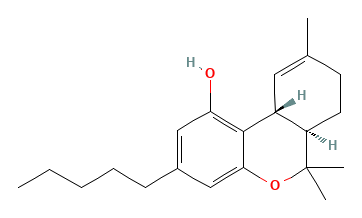
Rotate and inspect Δ9-Tetrahydrocannabinol in Molecule Studio — right in your browser